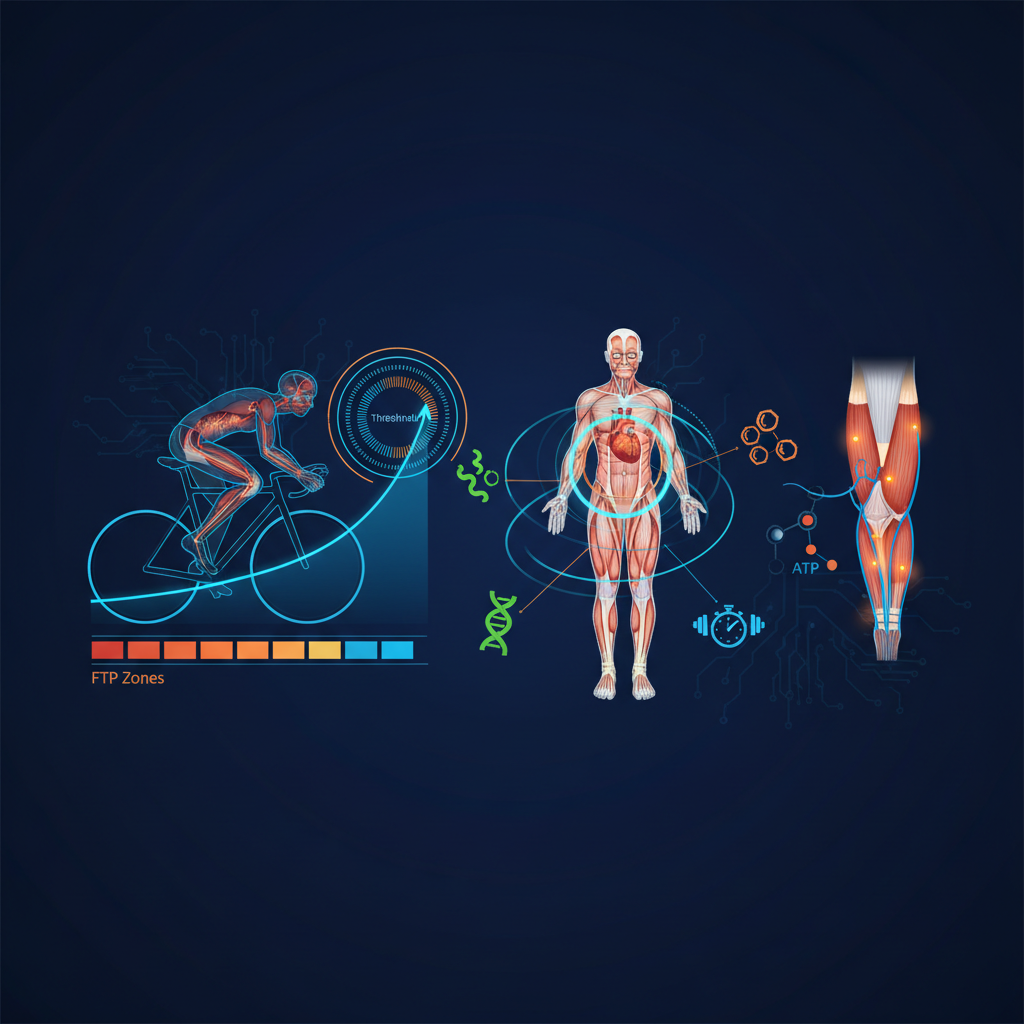
FTP & Power Output: How to Measure and Train Your Threshold
Welcome, athletes, to FitForge AI’s blog! Coach Voris — your NASM-certified personal trainer and Precision Nutrition coach — is here to demystify a crucial metric for cyclists and rowers: Functional Threshold Power (FTP). Understanding and training your FTP is key to unlocking significant performance gains, whether you’re crushing miles on the road or powering through a punishing erg session.
This guide will walk you through what FTP is, how to measure it, how to train within specific power output zones, and how to fuel your efforts for optimal results. Let’s dive in!
What is Functional Threshold Power (FTP)?
FTP is defined as the highest average power output a rider can sustain for approximately one hour. In simpler terms, it’s your sustainable power ceiling – the maximum intensity you can maintain without completely falling apart.
While the definition uses a one-hour benchmark, realistically measuring a true one-hour max effort is grueling and often impractical for regular training. Instead, FTP is typically estimated using shorter, maximal efforts:
- 20-Minute Test: This is the most common method. After a thorough warm-up, you perform a maximal effort for 20 minutes. Your average power during these 20 minutes is then multiplied by 0.95 to estimate your FTP.
- 5-Minute Test: A shorter, more intense test. Your average power for 5 minutes is multiplied by 0.90.
- Ramp Test: This test gradually increases power output until maximal exhaustion. Specialised software analyzes your performance to estimate FTP.
For rowers, the concept is similar, often referred to as lactate threshold or critical power, but the underlying principle of sustainable maximal aerobic power remains the same. While cycling primarily uses watts, rowing often uses pace (min/km or min/500m) and stroke rating alongside power metrics if available on modern ergs.
Why is FTP Important?
Knowing your FTP is like having a personalized blueprint for your training intensity. It allows you to:
- Train Smarter: Instead of guessing intensity, you can use precise power zones to target specific physiological adaptations.
- Track Progress: As your FTP increases, you know your fitness is improving, allowing you to adjust training intensity accordingly.
- Pace Yourself: Crucial for endurance events, FTP helps you understand how to best distribute your effort over longer durations.
Setting Up Your Power Meter/Erg
To measure FTP, you’ll need:
- Cycling: A power meter (crank-based, pedal-based, or spider-based) or a smart trainer that measures power output.
- Rowing: A modern rowing ergometer (like a Concept2) that provides power data (watts) and pace information.
Ensure your device is calibrated according to the manufacturer's instructions for accurate readings.
The NASM OPT Model & Power Training Zones
The National Academy of Sports Medicine's (NASM) Optimum Performance Training (OPT) model is often utilized, which emphasizes a periodized approach to training. Applying this to power-based training, several zones can be defined based on a percentage of your FTP:
Zone 1: Active Recovery (< 55% FTP)
- Physiological Goal: Enhance recovery, reduce muscle soreness, improve circulation.
- Training: Very low intensity, conversational pace. Think of it as a cool-down or a very easy spin/row the day after a hard workout.
- NASM Principle: Recovery and adaptation are crucial for long-term progress. Overtraining hinders results.
Zone 2: Endurance (75-90% FTP)
- Physiological Goal: Improve aerobic capacity, fat utilization, muscular endurance.
- Training: Sustainable for long durations (hours). You can hold a conversation, but it requires some effort.
- NASM Principle: Building a strong aerobic base is fundamental before progressing to higher intensities.
Zone 3: Tempo (90-105% FTP)
- Physiological Goal: Increase lactate processing capability, enhance muscular endurance at higher intensities.
- Training: Comfortably hard. Conversations become shorter, broken sentences. Sustained for 20-60 minutes.
Zone 4: Lactate Threshold (105-120% FTP)
- Physiological Goal: Increase the intensity at which lactate accumulates faster than it can be cleared. This directly raises your FTP!
- Training: Hard, but sustainable for 10-30 minutes at a time. Talking is difficult, only a word or two.
- NASM Principle: This zone is key for increasing your sustainable power ceiling. Progressive overload is vital here – gradually increasing the duration or number of intervals in this zone.
Zone 5: VO2 Max (120-150% FTP)
- Physiological Goal: Improve maximal oxygen uptake and delivery. Boosts top-end power and speed.
- Training: Very hard, short intervals (3-8 minutes) with significant recovery periods. Talking is impossible.
Zone 6: Anaerobic Capacity (> 150% FTP)
- Physiological Goal: Enhance the body's ability to produce energy anaerobically, improve sprint power.
- Training: Maximal efforts lasting seconds to a couple of minutes. All-out sprints.
Performing Your FTP Test: A Practical Guide
Get your free Day 1 workout — no card required.
Meet Andy — get your free Day 1 workoutHere is how it goes into practice. Here’s how to conduct a 20-minute FTP test:
- Warm-up (15-20 min): Start with 5-10 minutes of easy spinning/rowing (Zone 1), gradually increasing intensity over the next 5-10 minutes, including a few short (30-60 second) bursts at Zone 4/5 intensity to prepare your body.
- Test Set (20 min): After a brief (5 min) recovery spin/row, start your 20-minute maximal effort. Aim for a power output that you believe you can hold consistently for the entire 20 minutes. It should be hard enough that you can’t speak more than a word or two.
- Cool-down (10-15 min): Finish with easy spinning/rowing in Zone 1 to aid recovery.
Calculation: Take the average power (watts) from your 20-minute test and multiply it by 0.95. This is your estimated FTP.
Example: If your average power for 20 minutes was 300 watts, your FTP would be 300 * 0.95 = 285 watts.
Training with Power Zones
Once you have your FTP, you can structure your workouts using the zones:
- Endurance Rides/Rows (Zone 2): Build your aerobic base. Aim for longer durations, accumulating hours in this zone throughout the week.
- Threshold Intervals (Zone 4): Increase your FTP. Examples: 2x10 minutes at 105% FTP with 5 min recovery, or 3x8 minutes at 110% FTP with 4 min recovery.
- VO2 Max Intervals (Zone 5): Improve top-end power. Examples: 5x4 minutes at 125% FTP with 4 min recovery.
- Sweet Spot Training (90-95% FTP): A popular subset of Zone 3/lower Zone 4, offering significant threshold improvements with less fatigue than pure threshold work. Example: 3x15 minutes at 92% FTP with 5 min recovery.
Progressive Overload: To continue improving, you must gradually increase the demands on your body. This can mean:
- Increasing the duration of intervals.
- Increasing the number of intervals.
- Increasing the intensity (power output) slightly within a zone.
- Decreasing the rest period between intervals.
Periodize your training, following phases similar to the NASM OPT model (e.g., Stabilization Endurance, Strength Endurance, Hypertrophy, Max Strength) before peaking for a specific event or goal.
Fueling Your Performance: Nutrition for Power Athletes
Training hard requires smart fueling. Precision Nutrition emphasizes a whole-foods approach, focusing on nutrient timing and adequate macronutrient intake.
Key Macronutrients:
- Carbohydrates: Your primary fuel source, especially for high-intensity efforts. Focus on complex carbs (oats, quinoa, sweet potatoes, fruits) for sustained energy and simple carbs (fruit, sports drinks) around workouts.
- Protein: Essential for muscle repair and adaptation. Aim for lean sources (chicken, fish, beans, tofu, eggs).
- Fats: Important for hormone production and overall health. Focus on unsaturated fats (avocado, nuts, seeds, olive oil).
Precision Nutrition Hand-Portion Method Quick Guide:
For a balanced meal, visualize your plate:
- Protein: One palm-sized portion (fish, chicken, tofu, beans).
- Vegetables: Two cupped-hand portions (broccoli, spinach, salads).
- Carbohydrates: One closed-fist portion (rice, pasta, potatoes, quinoa).
- Fats: One thumb-sized portion (oils, nuts, seeds -- integrate into cooking or add as toppings).
Nutrient Timing:
- Pre-Workout (1-3 hours before): A balanced meal rich in carbs and moderate protein.
- During Long/Intense Workouts (>90 min): Consume 30-60g of carbohydrates per hour (e.g., sports drinks, gels, chews, or easily digestible foods like bananas).
- Post-Workout (within 30-60 min): Aim for a 3:1 or 4:1 ratio of carbohydrates to protein to replenish glycogen stores and kickstart muscle repair. A smoothie with fruit and whey protein is a great option.
Consistency is Key
Measuring your FTP and training within specific zones provides a powerful framework for improvement. However, the most effective training plan is one that you can consistently adhere to. Listen to your body, prioritize recovery, and fuel appropriately.
Ready to take the guesswork out of your training and unlock your true potential? Start your personalized journey with FitForge AI today! Take advantage of the free trial and explore how data-driven insights can revolutionize your performance.
Need to calculate your FTP on the fly? Check out the handy Calculator!
- Tags: functional threshold power, FTP cycling, power zones, rowing power, endurance training
Frequently Asked Questions
What is Functional Threshold Power (FTP) and why is it important for athletes?
Functional Threshold Power (FTP) represents the highest average power output an athlete can sustain for approximately one hour. It's a critical metric for cyclists and rowers because it establishes personalized training zones, allowing for more efficient and effective workout prescription that targets specific physiological adaptations for performance improvement.
How can I accurately measure my FTP? Are there different testing protocols?
FTP can be accurately measured through various protocols, commonly including a 20-minute maximal effort test, where 95% of your average power during that 20 minutes estimates your FTP. Other methods include ramp tests or critical power tests, each requiring specific warm-ups and sustained effort to derive a reliable threshold value.
Once I know my FTP, how do I use it to structure my training?
After establishing your FTP, you can define personalized power zones (e.g., Zone 1 Recovery, Zone 2 Endurance, Zone 3 Tempo, Zone 4 Threshold, Zone 5 VO2 Max, Zone 6 Anaerobic). Each zone corresponds to a percentage of your FTP, guiding your workout intensity to target different energy systems and fitness adaptations for optimal training efficiency.
How often should I re-test my FTP to ensure my training zones are current?
It is recommended to re-test your FTP every 4-8 weeks, or after a significant training block, to ensure your training zones accurately reflect your current fitness level. Consistent re-testing accounts for physiological adaptations, preventing training plateaus and ensuring you're always working at the optimal intensity for continued progress.
Get your free Day 1 workout — no card required.
Meet Andy — get your free Day 1 workout