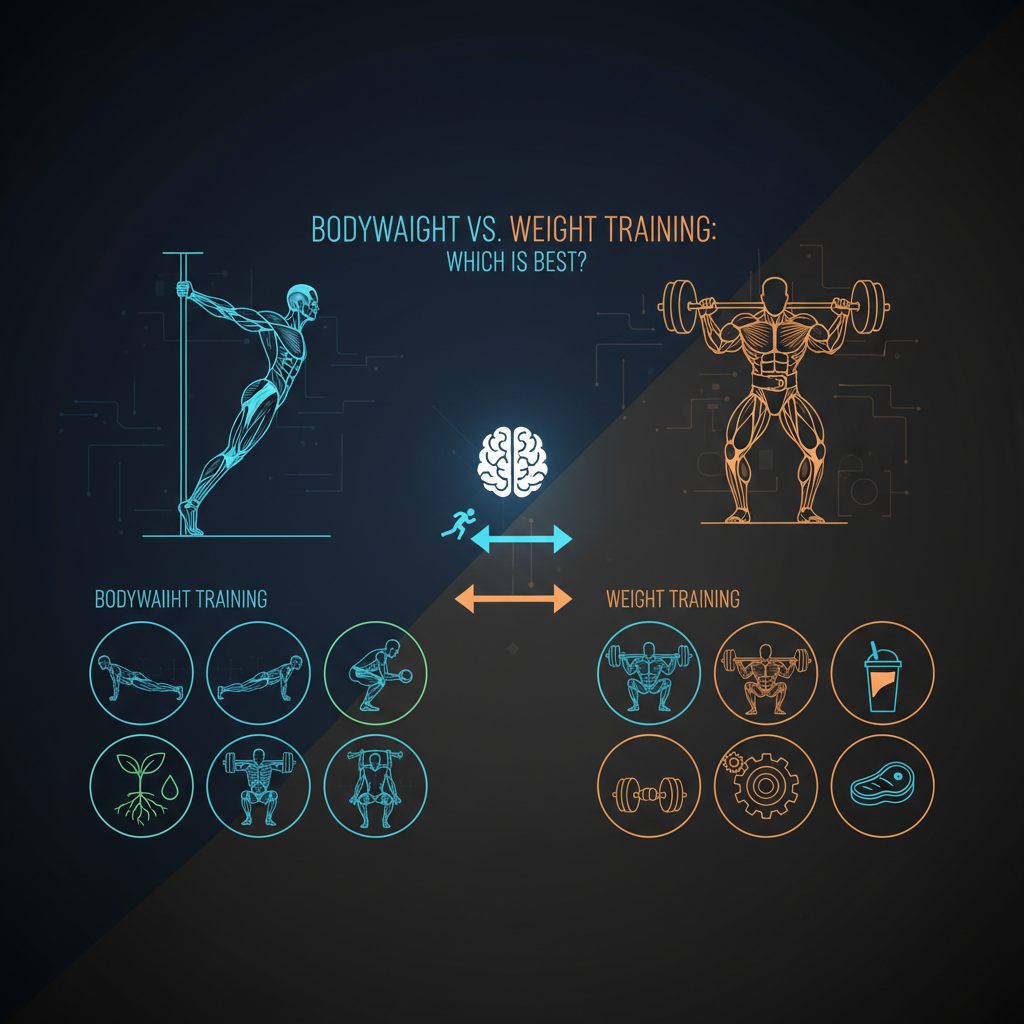
Bodyweight vs. Weight Training: Which Reigns Supreme for Your Fitness Goals?
The age-old question: When it comes to building muscle, shredding fat, and achieving peak physical condition, is it better to rely on the power of your own bodyweight or embrace the()` }physical challenge of external weights? FitForge AI understands that no two fitness journeys are the same. That's why this guide cuts through the noise with an evidence-based, no-nonsense comparison of bodyweight training versus weight training. Whether you’re a seasoned athlete or just starting, this guide will help you forge your path to success.
Understanding the Core Principles
Before diving into the ring, some foundational training principles need establishing, as espoused by organizations like the National Strength and Conditioning Association (NSCA) and the American Council on Exercise (ACE). Both bodyweight and weight training can be effective, but how they elicit adaptations and who they best serve depends on several factors:
- Progressive Overload: This is the bedrock of all strength and muscle gain. To continually improve, you must gradually increase the demands placed on your muscles. This can be achieved by increasing weight, reps, sets, decreasing rest time, or increasing exercise difficulty.
- Specificity: Your training should be specific to your goals. If you want to improve your vertical jump, you need to incorporate plyometrics. If you want to deadlift more weight, you need to deadlift.
- Recovery: Muscle growth and repair happen during rest. Overtraining without adequate recovery will hinder progress and increase injury risk.
Bodyweight Training: The Ultimate Accessibility
Bodyweight training, also known as calisthenics, utilizes your own mass as resistance. Think push-ups, squats, lunges, planks, and pull-ups.
Pros of Bodyweight Training:
- Accessibility & Convenience: No gym membership or equipment needed. You can train anywhere, anytime. Perfect for home workouts, travel, or when time is tight.
- Develops Foundational Strength & Stability: Exercises like planks and variations engage the core deeply, improving overall stability and preventing injury.
- Enhances Body Control & Coordination: Mastering complex bodyweight movements like handstands or muscle-ups requires significant coordination and proprioception.
- Low Barrier to Entry: Most bodyweight exercises can be modified to be easier or harder, making them suitable for all fitness levels.
- Cost-Effective: Free!
Cons of Bodyweight Training:
- Progressive Overload Can Be Tricky: While you can increase reps, sets, or slow down the tempo, achieving significant muscle hypertrophy (growth) solely through bodyweight can become challenging once you reach a certain strength level. Advanced progressions can be difficult to learn and master.
- Limited Options for Lower Body Hypertrophy: While variations like pistol squats are incredibly demanding, achieving the same level of quads and hamstring growth as with heavy barbell squats can be difficult for some individuals.
- Requires Creativity for Advanced Training: To keep progressing, you'll need to explore more complex variations or implement techniques like tempo training, pauses, and isometrics.
NASM-Aligned Bodyweight Programming Considerations:
- Focus on Compound Movements: Prioritize exercises that work multiple muscle groups simultaneously (squats, lunges, push-ups, rows, pull-ups).
- Vary Angles and Planes of Motion: Don't just do standard push-ups. Incorporate incline, decline, wide-grip, and close-grip variations. Train in different planes (sagittal, frontal, transverse).
- Incorporate Plyometrics: For power development, add jump squats, clapping push-ups, and box jumps (using a stable surface).
- Master Form: Perfect technique is paramount to prevent injury and maximize effectiveness. Less weight means poor form is more noticeable and potentially more harmful to joint mechanics.
- Utilize Tempo: Manipulating the speed of the eccentric (lowering) and concentric (lifting) phases can increase time under tension and muscular demand.
Weight Training: The Classic Strength Builder
Weight training involves using external resistance like dumbbells, barbells, kettlebells, and resistance machines.
Pros of Weight Training:
- Direct Progressive Overload: Easily increase the weight lifted to continually challenge muscles, making it highly effective for strength and hypertrophy.
- Targeted Muscle Development: Allows for isolation of specific muscle groups, ideal for addressing weaknesses or focusing on aesthetic goals.
- Wide Variety of Exercises: Access to a vast array of movements that can target every muscle from every angle.
- Bone Health Benefits: Lifting heavy weights is a potent stimulus for increasing bone density, crucial for long-term health and injury prevention.
- Metabolic Boost: Significant resistance training can lead to a greater "afterburn" effect (EPOC), contributing to fat loss.
Get your free Day 1 workout — no card required.
Meet Andy — get your free Day 1 workoutCons of Weight Training:
- Requires Equipment & Gym Access: Can be costly and less convenient than bodyweight training.
- Higher Risk of Injury (If Form is Poor): Lifting heavy loads with improper technique can lead to significant injury.
- Can Be Intimidating for Beginners: The gym environment and complex lifts can be daunting for newcomers.
- Less Emphasis on Proprioception/Coordination (Compared to Advanced Calisthenics): While lifting requires balance, it doesn't typically demand the same level of full-body coordination as advanced bodyweight skills.
NASM-Aligned Weight Training Programming Considerations:
- Periodization: Structure training in cycles (e.g., macrocycles, mesocycles, microcycles) to manage intensity and volume, prevent plateaus, and optimize results.
- Proper Exercise Selection: Choose exercises that align with the client's goals, fitness level, and movement capabilities. Start with foundational compound lifts before moving to more complex variations.
- Controlled Eccentric Phase: Emphasize the lowering portion of the lift (typically 2-4 seconds) to maximize muscle damage and subsequent growth.
- Full Range of Motion: Unless contraindicated, aim for a complete range of motion to maximize muscle activation and flexibility.
- Listen to Your Body: Recovery is key. Implement deload weeks and monitor for signs of overtraining.
Bodyweight vs. Weight Training: Which is Right for YOU?
The "best" approach isn't about choosing one exclusively but understanding how each can serve your specific goals.
- For Absolute Beginners: Bodyweight training is often ideal. It allows you to build a solid foundation of strength, coordination, and muscular endurance without the immediate risk associated with heavy weights. You can learn fundamental movement patterns and build confidence. Check out the Beginner Bodyweight Workouts.
- For Fat Loss: Both can be effective! High-intensity interval training (HIIT), whether bodyweight or weight-based, is excellent for calorie expenditure. Combining strength training (either type) with cardiovascular exercise and a dialed-in nutrition plan is key. Use the Calorie Burn Calculator to estimate your needs.
- For Muscle Hypertrophy (Building Size): Weight training generally offers a more direct and efficient path due to the ease of progressive overload. However, advanced bodyweight practitioners can achieve significant muscle growth. A hybrid approach is often optimal.
- For Strength Gains: Weight training, particularly focusing on compound barbell lifts (squat, bench press, deadlift), is king for maximal strength development.
- For Athletes (Specific Skills): The choice depends on the sport. Gymnasts rely heavily on bodyweight mastery. Powerlifters focus on maximal strength with weights. Many athletes benefit from a combination.
- For Limited Equipment/Space: Bodyweight training is your clear winner.
- For Overall Fitness & Healthspan: Both are excellent! A balanced approach incorporating elements of both, alongside flexibility and cardiovascular training, promotes longevity and functional independence. Ready to find your starting point? Take the Fitness Assessment Quiz!
The Hybrid Approach: The Best of Both Worlds
Why choose? The most effective training programs often blend bodyweight and weight training.
- Use weights for primary strength drivers: Squats, deadlifts, presses, rows.
- Incorporate bodyweight for: Core stability (planks, anti-rotation), accessory work (pistol squats, pull-up variations), mobility, and explosive power (plyometrics).
This combination allows you to reap the benefits of progressive overload for strength and hypertrophy while also developing the functional strength, coordination, and resilience that bodyweight training uniquely offers.
Conclusion: Forge Your Path with FitForge AI
Ultimately, the "bodyweight vs. weight training" debate is less about which is superior and more about which tool best serves your current goals and circumstances. Both modalities, when programmed intelligently using evidence-based principles, can lead to incredible transformations.
The key is consistency, progressive overload, and listening to your body. Don't get bogged down in the "either/or." Focus on the "how" and "why."
Ready to build a training plan that integrates the best of both worlds, tailored specifically for you?
Unlock your potential with FitForge AI! Start your FREE 7-day trial today and gain access to personalized workout plans, expert guidance, and the tools you need to achieve your fitness goals.
Tags: bodyweight training, weight training, strength training, calisthenics, fitness goals
Frequently Asked Questions
What are the primary benefits of bodyweight training?
Bodyweight training excels in developing functional strength, improving mobility, and enhancing body control, often with reduced risk of injury. Its accessibility and versatility make it ideal for individuals with limited equipment or space.
When is weight training a more effective choice for fitness goals?
Weight training is generally superior for maximizing muscle hypertrophy and absolute strength gains due to its ability to provide progressive overload through exact resistance increments. It allows for advanced specialization and targeted muscle development not always achievable with bodyweight alone.
Can bodyweight and weight training be effectively combined?
Absolutely. Integrating both modalities can offer a comprehensive approach to fitness, leveraging the functional benefits of bodyweight exercises alongside the strength and muscle-building capacity of weight training. This hybrid approach allows for varied stimuli and addresses a wider range of fitness adaptations.
Which training method is better for fat loss?
Both bodyweight and weight training can be highly effective for fat loss, primarily by building muscle mass, which increases resting metabolic rate. The key factor is consistency and the creation of a caloric deficit, often achieved through high-intensity variations or compound movements regardless of the equipment used.
Get your free Day 1 workout — no card required.
Meet Andy — get your free Day 1 workout