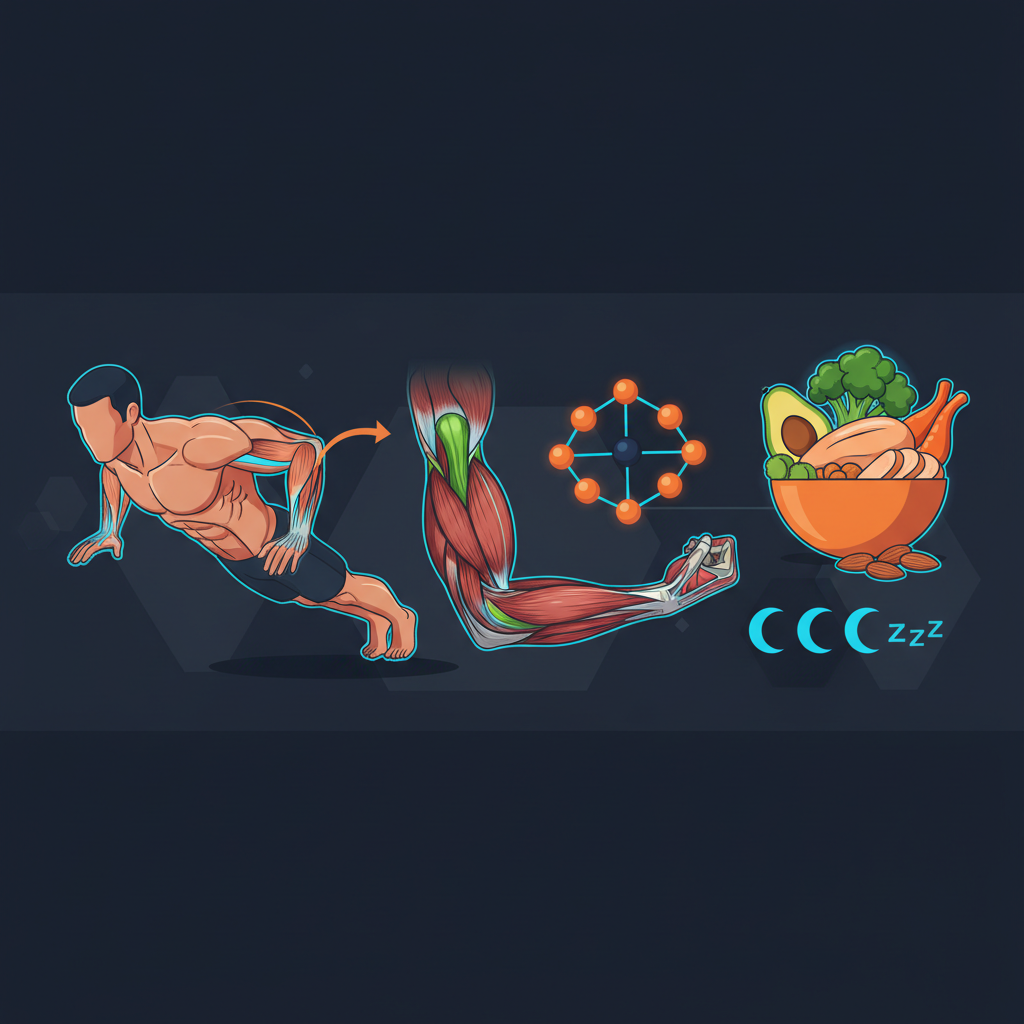
Ditch the Dumbbells: Built Arms Without the Gym
Alright, listen up. You want bigger arms. You don't have a gym membership, or maybe life just got in the way of your barbells. Excuses? Not here. You think you need heavy iron to sculpt impressive triceps and biceps? Think again. Coach Voris — a NASM-certified Personal Trainer and Precision Nutrition Coach — will tell you that with the right strategy, your own bodyweight can be a powerful tool for hypertrophy.
Forget the fluff. This isn't about fancy machines or secret supplements. It's about intelligent application of foundational principles: progressive overload, proper form, and consistent effort. Here are 8 bodyweight movements, often overlooked, that will force your arm muscles to adapt and grow. It all then ties into a structured 12-week program designed for results.
The Science of Bodyweight Arm Hypertrophy
Cut to the chase: muscle growth, or hypertrophy, primarily occurs when muscles are subjected to sufficient mechanical tension, muscle damage, and metabolic stress, as outlined by leading organizations like the American College of Sports Medicine (ACSM) and the National Strength and Conditioning Association (NSCA). Many assume this requires heavy weights. However, research continually shows that effective hypertrophy can be achieved across a wide range of loads, provided effort is high and sets are taken close to failure (Schoenfeld, 2010).
With bodyweight, the "load" is fixed, but we manipulate tension and metabolic stress through variations in leverage, tempo, range of motion, and advanced techniques like drop sets and advanced rest periods. The targets are the biceps (responsible for elbow flexion and forearm supination) and triceps (the three-headed muscle responsible for elbow extension), hit with precision.
The 8 Bodyweight Arm Builders
These aren't your basic push-ups. The approach adapts and innovates to create real challenge and stimulate growth. Focus on slow, controlled movements, feeling the muscle work, and pushing to near failure.
1. Close-Grip Push-Ups (Triceps Focus)
How to: Start in a standard push-up position. Bring your hands closer together, directly under your chest, with fingers pointing forward. Lower your chest towards your hands, keeping your elbows tucked close to your body. Drive back up, squeezing the triceps at the top. Why it works: This variation significantly increases the load on the triceps compared to a standard push-up, hitting all three heads. It’s a compound movement that’s easily scalable.
2. Diamond Push-Ups (Advanced Triceps)
How to: Form a diamond shape with your hands by touching your thumbs and index fingers together directly under your sternum. Perform a push-up, keeping elbows tucked. Why it works: An even more challenging progression from the close-grip push-up, placing maximum stress on the triceps. If you can’t complete these with good form, stick to close-grip.
3. Bench Dips (Triceps Isolation)
How to: Sit on the edge of a sturdy chair or bench, hands gripping the edge beside your hips, fingers pointing forward. Slide your hips off the bench. Lower your body by bending your elbows to about 90 degrees, keeping your back close to the bench. Push back up using your triceps. For added challenge, elevate your feet. Why it works: A fantastic isolation movement for the triceps, allowing for a good stretch at the bottom and a powerful contraction at the top.
4. Pike Push-Ups (Shoulder/Triceps Hybrid)
How to: Start in a push-up position, then walk your feet closer to your hands, lifting your hips high into an inverted 'V' shape. Keep your legs and back straight. Lower the top of your head towards the floor by bending your elbows, ensuring your elbows point slightly backward, not out to the sides. Push back up. Why it works: While primarily a shoulder exercise, the pike push-up heavily engages the triceps as secondary movers, especially in the pressing phase.
5. Chin-Ups (Biceps and Back)
How to: Find a sturdy horizontal bar. Grab the bar with an underhand grip (palms facing you), hands shoulder-width apart. Hang freely. Pull yourself up until your chin clears the bar, focusing on initiating the movement with your lats and squeezing your biceps. Lower slowly. Why it works: This is the king of bodyweight bicep builders. While targeting the back, chin-ups put immense eccentric and concentric tension on the biceps. If you can't perform a full chin-up, use an assisted band or negative chin-ups.
6. Inverted Rows (Biceps and Back)
How to: Position yourself under a low, sturdy bar (a kitchen table edge can work in a pinch for some). Grab the bar with an underhand grip, hands roughly shoulder-width apart. Extend your legs out in front of you, keeping your body in a straight line. Pull your chest towards the bar, squeezing your biceps and back. Lower slowly. Adjust foot position to change difficulty (feet further forward = harder). Why it works: A highly scalable bicep and back exercise that allows you to control the intensity based on your body angle. Focus on actively squeezing the biceps.
7. Commando Pull-Ups (Biceps/Forearm Emphasis)
How to: Similar to a chin-up, but you grab the bar with one hand facing you and the other facing away, or grasp it lengthwise so both hands are facing each other (like holding a baseball bat). Pull yourself straight up, leading with one shoulder, then switch leading shoulders on the next rep or set. Why it works: This variation places unique stress on the biceps and forearms due to the altered grip and asymmetrical pull.
Get your free Day 1 workout — no card required.
Meet Andy — get your free Day 1 workout8. Bicep Bodyweight Curls (Advanced Isolation)
How to: This requires creativity. Find a low, sturdy bar or even the edge of a sturdy table. Lie on your back underneath it. Grip the bar with an underhand grip, hands shoulder-width. Keep your body rigid, engaging your core and glutes. Curl your upper body towards the bar, primarily by bending at the elbows, squeezing your biceps. The lower your body position relative to the bar, the harder it is. You can also elevate your feet. Why it works: This is the closest you'll get to an isolation bicep curl with bodyweight. It’s challenging and requires good mind-muscle connection.
The 12-Week Bodyweight Arm Program
This program is designed for progressive overload. You'll work your arms 2-3 times per week, with at least 48 hours of rest between sessions for optimal recovery and growth. Each session will involve 3-4 exercises for the triceps and 3-4 exercises for the biceps.
Key Principles:
- Progressive Overload: Crucial for muscle growth. This means making the exercises harder over time.
- Increase Reps/Sets: Once you can comfortably hit the top end of the rep range, increase sets or reps.
- Decrease Rest: Shorter rest periods increase metabolic stress.
- Improve Form: Stricter form and slower tempo increase time under tension.
- Advanced Variations: Move to harder exercise variations (e.g., from Close-Grip to Diamond Push-ups).
- Tempo: Use a 2-0-2-1 tempo (2 seconds down, 0 pause, 2 seconds up, 1-second squeeze).
- Mind-Muscle Connection: Actively focus on contracting the target muscle.
- Nutrition & Recovery: Ensure adequate protein intake (1.6-2.2g per kg of bodyweight) and sufficient sleep. Your muscles grow outside the gym.
Workout Structure (Perform 2-3 times per week on non-consecutive days)
Warm-up (5-10 minutes):
- Light cardio (jumping jacks, high knees)
- Arm circles (forward and backward)
- Dynamic chest and shoulder stretches
Workout A (Monday/Thursday example)
- Triceps Superset 1:
- Close-Grip Push-Ups: 3-4 sets of 8-15 reps (or until 1-2 reps shy of failure)
- Bench Dips: 3-4 sets of 10-20 reps (or until 1-2 reps shy of failure)
- Rest 60-90 seconds between supersets
- Biceps Superset 2:
- Chin-Ups: 3-4 sets of as many reps as possible (AMRAP) with good form. (Aim for 5-10+ reps)
- Inverted Rows (Underhand Grip): 3-4 sets of 8-15 reps (or until 1-2 reps shy of failure)
- Rest 60-90 seconds between supersets
- Finisher:
- Diamond Push-Ups (as many as possible in 60 seconds) OR Bicep Bodyweight Curls (2 sets to failure)
Workout B (Tuesday/Friday example)
- Triceps:
- Diamond Push-Ups: 3-4 sets of AMRAP (aim for 6-12 reps per set) OR Pike Push-Ups: 3-4 sets of 8-15 reps
- Rest 60-90 seconds
- Biceps:
- Commando Pull-Ups: 3-4 sets of AMRAP (switch leading arm each set, aim for 4-8 reps per side)
- Rest 60-90 seconds
- Triceps Superset 2:
- Decline Close-Grip Push-Ups (feet elevated): 3 sets of 8-15 reps
- Triceps Extensions (using a sturdy lower bar/table, lying underneath): 3 sets of 10-15 reps
- Rest 60-90 seconds between supersets
- Finisher:
- Negative Chin-Ups (jump to the top, lower slowly for 3-5 seconds): 2 sets of 3-5 reps
Progression Over 12 Weeks:
- Weeks 1-4: Focus on mastering form and hitting the lower end of the rep ranges. If you can't do a full chin-up, do negative chin-ups (jump to the top, lower very slowly) and assisted chin-ups (using a chair or resistance band).
- Weeks 5-8: Aim to increase reps within the target range. Shorten rest periods by 15-30 seconds.
- Weeks 9-12: Introduce more challenging variations (e.g., elevated feet for push-ups/dips, slower eccentric phases for chin-ups). Consider adding one more set to each exercise.
Remember, consistency is king. Log your workouts to track progress. If you stop seeing progress, re-evaluate your form, nutrition, and recovery.
FAQ
Q: Can bodyweight really build significant arm mass?
A: Absolutely. While heavy weights are often associated with hypertrophy, the primary drivers are mechanical tension, metabolic stress, and muscle damage. Bodyweight exercises, when performed with sufficient intensity, proper tempo, and progressive overload (e.g., harder variations, higher reps/sets, shorter rest), can effectively stimulate all of these factors, leading to significant muscle growth.
Q: How often should I train my arms with bodyweight?
A: For optimal muscle growth, research suggests training a muscle group 2-3 times per week, allowing for adequate recovery. This program schedules arm work on 2-3 days, ensuring muscles have time to repair and grow. Listen to your body and adjust as needed.
Q: What if I can't do a pull-up or chin-up yet?
A: No problem! You can start with "negatives," where you jump to the top of the bar and slowly lower yourself down, controlling the descent for 3-5 seconds. You can also use resistance bands for assistance or perform elevated inverted rows, where your feet are on a higher surface, making the exercise more challenging. Consistency with these progressions will get you to a full chin-up.
Q: How important is nutrition for arm growth?
A: Extremely important. You can't build muscle without the raw materials. Ensure you're consuming enough protein (1.6-2.2 grams per kilogram of bodyweight) to support muscle repair and synthesis. Maintain a slight caloric surplus if your goal is size, and prioritize whole, unprocessed foods. Stay hydrated!
Q: Do I need any equipment for this program?
A: Minimal. A sturdy chair or bench for dips, a reliable pull-up bar (doorway pull-up bars are great for home use), and a low, sturdy bar or table edge for inverted rows and bodyweight bicep curls are all you truly need to follow this program effectively.
Forge Your Arms, No Gym Required
There you have it. A comprehensive bodyweight program designed to build bigger arms right from your home. No excuses, just results. Apply these methods with discipline, stay consistent with your nutrition, and watch your arms grow.
Ready to take your fitness to the next level? FitForge AI can help you meticulously track your progress, suggest variations, and adapt workouts to your unique needs and a growing knowledge of what works for YOU. Start your free trial today and let FitForge AI be your ultimate training partner.
Get your free Day 1 workout — no card required.
Meet Andy — get your free Day 1 workout